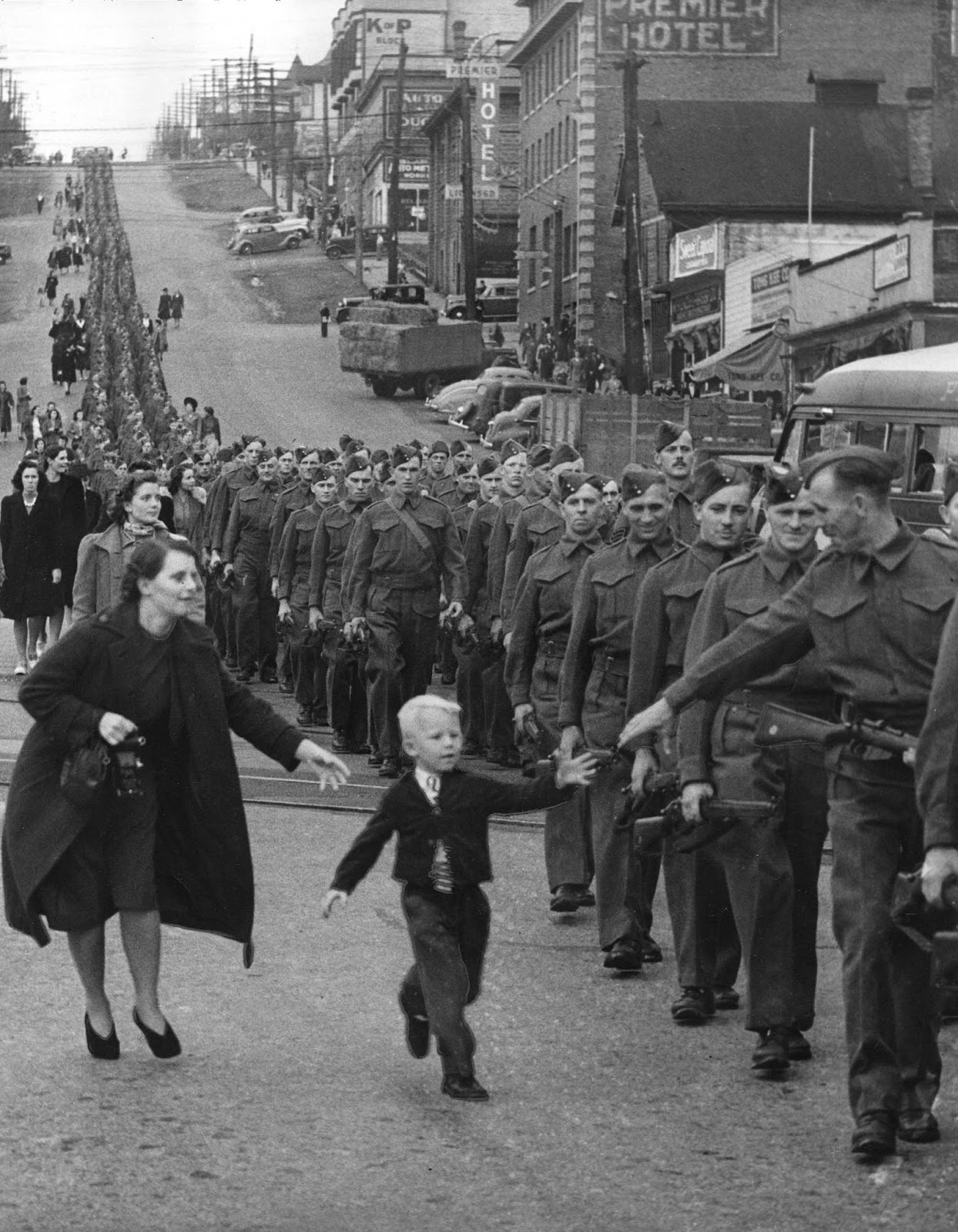
On 1 October 1940 a local newspaper photographer, Claude P. Dettloff, had readied himself to take a photo of the British Columbia Regiment marching through New Westminster, Canada, on their way to a yet undisclosed destination in the Second World War. His position appears carefully selected to capture a large section of the regiment as it appeared over the hill and proceeded down the street towards him. Yet he was unaware that from this vantage point he was about to grab an iconic war time photograph which would appear in Life magazine, be hung on school classroom walls, appear on Canadian coins and stamps, and eventually be replicated in the form of a bronze sculpture in the city 74 years later. As a young boy breaks away from his mother and reaches out to touch the hand of his departing soldier father, Dettloff was in place to photographically freeze a moment feted for decades as a representation of patriotism, sacrifice and bravery. Yet, despite the heart-pulling sentimentality of the image, and for all the meaning and significance imbued within this one extracted moment from an enormous narrative, this photograph has not held its value, it can be argued, in the archive of war photography, as a clarifying and true rendition of the catastrophe of war. It is, as Peter Anderson states, “…like the casings that remain on the field of battle long after the bullets…” (Anderson 198). It has become part of “…the immense detritus of war.” (Anderson 198.) It is a paradoxically deceitful photograph. The innocence of childhood snatched by the propaganda machine for the implantation of its ideas and agendas into public minds, to support the devastating violence of a global war - a slice of this destructive world event but taken through a superficial section, safe from the “splinters, shreds, smoke and dust, clods, broken machines, the buckets of amputations outside field hospitals, pamphlet drops, the litter of the battlefield.” (Anderson 203).
Judith Butler states in Frames of War, “In order for photographs to evoke a moral response, they must…appeal to our sense of moral obligation.” (Butler 68). The use of this photograph in schools and used, as it was, in the drive to increase war bond sales, was a tool of moral provocation, but limited to unwavering alignment with the patronage and approval of war. There is little place within the image in which to conduct an interrogative work over of the morality and rationalisation of deliberate human slaughter. This photograph was so rapidly and favourably adopted by the Canadian government and school authorities because it holds the viewer and, by extension, the nation, in a naïve analysis of the photograph’s content with the sufferings of war benignly, almost romantically, represented by a family’s reaching hands. There is no blood and guts despair, just a small family teaching the world the courage, and celebration even, of a wartime goodbye. With a small white-haired white boy, captured in the middle foreground, suspended almost between the two worlds of At Home and At War by his parents’ stretching towards him, his positional impact seduces the viewer into this picture of innocent collusion with the enlisting of thousands of men on a march to their possible deaths. This is how a family suffers, it seems to say, by sacrificing for an honourable cause. It gives no indication that the sacrifice may well be permanent. The boy’s white, neat hair in the black and white image gives the central figure an ethereal, unruffled quality against the surrounding dark colours, belying the fact that “Warfare aims… to wreak havoc… to bring about disorder, disarray, to disorganize the enemy until it can no longer be said to be.” (Anderson 203). It is the angelic, juxtaposed with hellish death, which now, decades later the viewer knows was coming. So did the authorities who drove the propaganda.
A dichotomy exists between the bottom half of the photograph and the top half, which increases the dissimulation of the scene. It could be said that the two halves tell different stories, and that they represent the differing perspectives seen by a viewer of the image during those wartime years, and a present-day observer. The photograph above the head of the boy’s mother has been sealed for scrutiny by those looking back from the future. It appears untouched by the small drama playing out below which belongs wholly to the people of the time. The mother, father and child show no anguish, their expressions are warm, earnest. Several surrounding soldiers smile, even the guns in their hands visually fade behind the endearing tableau. It is a scene stealer, a distraction, allowing a curtain to be quietly drawn over the realities of violent death in service to King and Country, while it hung in classrooms priming young minds to identify with the gallant little hero. A modern viewer, enlisting time and hindsight, can thaw the frozen image and dismantle its significance by knowing that the boy is an old man, that millions of humans died in World War II, undoubtedly many in the photograph, and that propaganda did not win wars, nor did wars stop wars. The future viewer understands that. Behind the dominant foreground setting, countless men march. Paradoxically, it is this gloomy procession, the overlooked portion of the photo, that does go some way to representing the realities of war. It is a spectre-like cortege. Some soldiers have identifiable faces, every other conscript fades into the metamorphosis from a single human being into a single unit called an army, “…re-allocating his individuality to a simple function in the collective.” (Anderson 199). This long line of approaching faceless men bears down along the edge of the frame, waiting to enter the space of humanness again, calling to the reader to look up and give it meaning. But the modern viewer knows that it never will, that it can only be redispersed into personhood by future generations who know of and speak of their fates. This dark smudge of humanity coming over the hill, reduces conflict to a collective fighting a collective, contrasting sharply with the dominant Hallmark family scene, which believes it can squash the colossal agony of war into the minutiae of hands.
The photograph presents two great contrasts which further reinforce the delusory aspect of the image. While men uniformly proceed to an arena of death and mayhem, townsfolk go about their business. Some stand outside stores on the pavements watching the procession in what appears to be an interlude to their everyday pursuits. A loaded truck represents a continuum of the mundane in the face of the unthinkable. Even the cars are parked facing inwards towards the stores, not backed in as an acknowledgement or applaud to the departing regiment. The people who do close in around the men appear as pall bearers alongside a coffinlike shape of walking dead men. Yet only the future really knows; the future is best placed to put meaning and significance to the top part of the image, whilst the bottom scene would have a weak pushback against an accusation of being staged.
Anderson states, “The reader of a photograph taken for one purpose may find it for another.” (Anderson 203). Dettloff’s photograph is one of contrasts and compartments. The main attraction could comfortably take its place within the ethos of the American Dream, a proponent of its ideals of freedom, success, and a better life. But it speaks to the modern reader of an unconvincing, utopian model response to the wrenching apart of families and communities, a static and misleading moment. The authentic photograph exists above and beyond this, in the faces of the men unaware of the propaganda headline below, or could be found among the bystanders, unsure if they are witnessing a victory or a funeral march. The photograph is historically useful only insofar as it informs today’s viewer of the indoctrinations vital in keeping the endless line of troops marching to war, and how those ideas could so easily be hung off one small boy.
Bibliography
- P.R. Anderson (2014) On Photographs at War: Images of the South African 6th Armored Division in Italy 1944–1945, Safundi, 15:2-3, 197-225, DOI: 10.1080/17533171.2014.925643
- Butler, Judith. Frames of War. Verso, London/New York. 2009.
- Dettloff, Claude. “Wait For Me, Daddy.” https://rarehistoricalphotos.com/wait-for-me-daddy-1940/